
Learn Bitcoin
Build a solid foundation before you invest a single dollar.
What is Bitcoin?
Created in 2009, Bitcoin is decentralized digital money — no banks, no governments, no middlemen. Transactions move peer-to-peer directly between wallets, recorded permanently on a public blockchain. Bitcoin's total supply is mathematically capped at 21 million coins, hardcoded and unchangeable. That fixed scarcity is the foundation of its value. In 2026, Bitcoin has evolved from a fringe experiment into a global financial asset held by institutions, governments, and millions of individuals worldwide.
How Blockchain Works
Bitcoin runs on a blockchain — a distributed ledger replicated across thousands of nodes worldwide. When you send Bitcoin, the transaction is broadcast to the network, validated by nodes using cryptographic algorithms, then permanently added to a block. Each block links to the previous one, making the chain tamper-proof. No single entity controls it. See the visual explainer below.
Wallets & Keys
Start with a hardware, desktop, or mobile wallet — and hold your own keys. Your recovery phrase is the master key to your funds: keep it secret, keep it offline, never share it. Avoid web wallets. When buying a hardware wallet, purchase directly from the manufacturer only.
Bitcoin vs. Altcoins
Bitcoin is the only crypto with a credible claim to "digital gold" — fixed supply, proof-of-work security, and over 58% of the entire crypto market cap. Altcoins like Ethereum power smart contracts and DeFi; Solana targets speed and gaming. Most altcoins carry significantly higher risk — many don't survive a bear market. For a first investment, Bitcoin is the benchmark. Research thoroughly before venturing into altcoins, and always check market cap ranking first.
Security Best Practices
Move crypto onto an exchange only when you intend to trade — then move it back. Never leave your crypto sitting on an exchange long-term. Exchanges are custodians, not vaults. If you don't control the keys, you don't control the coins.
Bitcoin Cycles
Bitcoin has historically followed a four-year cycle tied to its halving events — every 210,000 blocks, the mining reward is cut in half, tightening supply. Major bull market peaks have landed in late 2013, late 2017, and late 2021. The pattern: roughly one year of parabolic advance, one year of severe drawdown, then two years of recovery and accumulation into the next cycle.
The Bitcoin Halving
Every ~4 years the mining reward is cut in half — historically the single biggest driver of Bitcoin bull markets.
Halving History & Schedule
Each halving tightens supply. If demand holds, basic economics says the price rises.
How Blockchain Works
Visualizing the network — from decentralized structure to transaction flow.
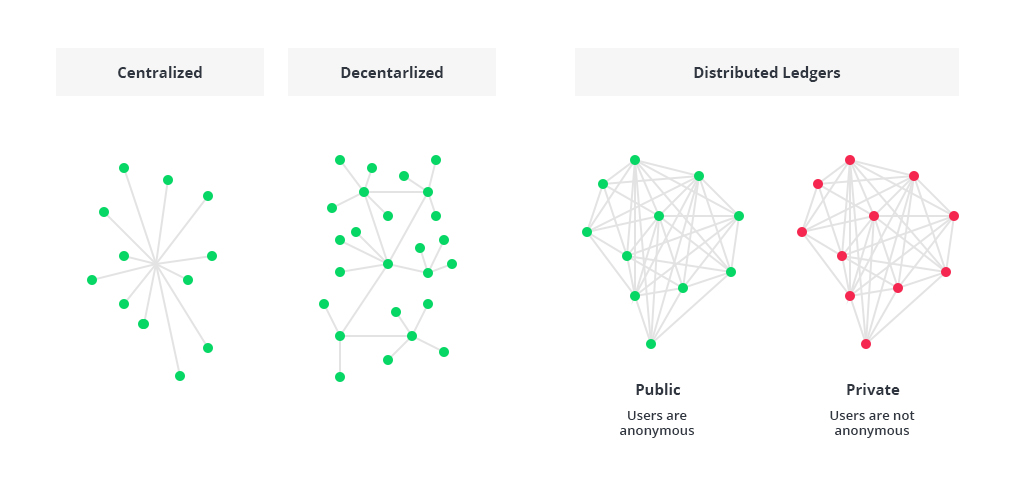
Centralized vs. Decentralized vs. Distributed Ledgers
Bitcoin runs on a decentralized, public distributed ledger — no single point of control, and all participants are anonymous. This is what makes it censorship-resistant and trustless.
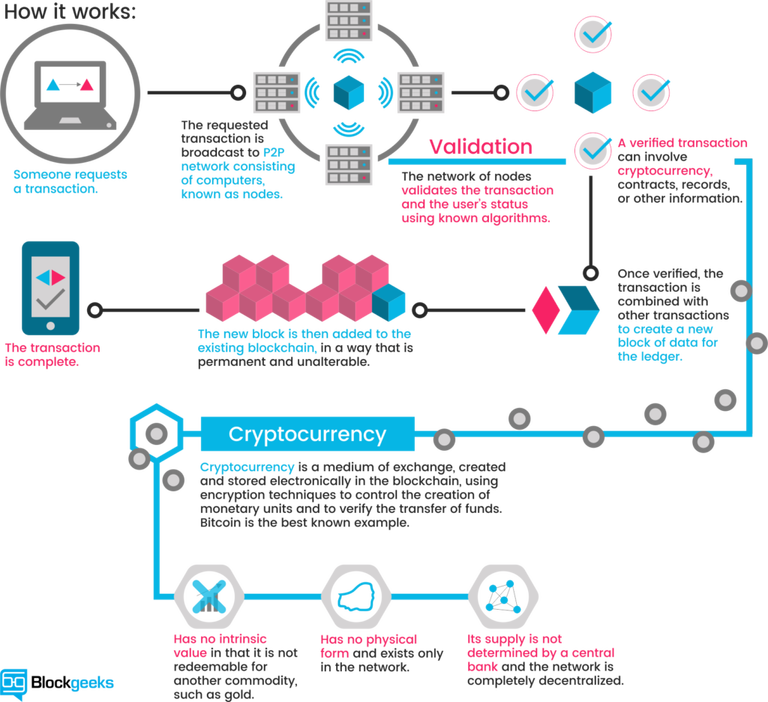
How a Transaction Flows Through the Network
When you send Bitcoin, your transaction is broadcast to thousands of nodes. The network validates it using known algorithms, then permanently adds it to the blockchain — immutable and tamper-proof. Cryptocurrency is a medium of exchange stored in the blockchain: no intrinsic value, no physical form, and no central authority controlling supply.
Fundamental & Sentiment Analysis
Technical analysis tells you when. Fundamental analysis tells you what. Use both.
Researching a Project
Before buying any crypto, read the whitepaper (what problem does it solve?), check the team (are they public and credible?), examine tokenomics (total supply, unlock schedule, inflation rate), and look at real usage metrics (daily active addresses, total value locked for DeFi). A compelling narrative with no on-chain activity is a red flag.
On-Chain Metrics
On-chain data shows what's actually happening on the blockchain — not what people are saying. Key metrics: Active Addresses (network usage), Exchange Net Flow (coins moving to exchanges suggest selling pressure; coins leaving suggest accumulation), NVT Ratio (Network Value to Transactions — a valuation measure), and MVRV Z-Score (identifies market tops and bottoms historically).
Sentiment & Social Signals
Follow developments on X (Twitter), Reddit, and Discord — but verify everything before acting. The crowd is often wrong at extremes. Extreme bullish sentiment on social media historically correlates with market tops. Use the Fear & Greed Index as a quick sentiment read. Treat viral narratives as a lagging indicator, not a signal to buy.
Macro & Regulatory Context
Crypto does not exist in a vacuum. Interest rate decisions by the Fed affect risk appetite globally. A stronger US Dollar (DXY rising) typically pressures Bitcoin. Regulatory news — new ETF approvals, exchange restrictions, tax rule changes — can move prices 10–20% overnight. Track these as background context for any position you hold.
Tokenomics — Supply Matters
Understand the supply structure of any asset you buy. Bitcoin's 21M fixed cap is the gold standard. Many altcoins have high inflation (new tokens unlocking monthly) that creates persistent sell pressure. Check: What is the current circulating supply vs. total supply? When do team/investor tokens unlock? A great project can underperform purely due to supply dynamics.
DYOR — Avoiding Hype & Scams
Do Your Own Research. Influencer promotions, Telegram signal groups, and "next 100x" narratives are often paid promotions or outright scams. Check if the project has a working product (not just a roadmap), an active GitHub, and organic community growth. If someone is louder about price than utility, that's the signal.
Go Deeper
Full guides on the topics that matter most.
Bitcoin Security
The full security playbook — scam anatomy, exchange vetting, self-custody, the seed phrase rules, and 8 unbreakable fundamentals. Includes a 2025–2026 incident timeline and a Canadian-specific quick-reference card.
Read Security Guide →Hardware Wallet Deep Dive
Ledger Nano X vs. Tangem vs. Coldcard Mk4 — scored across 6 security dimensions, full pro/con analysis, spec sheets, and a pick-your-scenario decision guide. Honest, unsponsored, updated April 2026.
Compare Wallets →